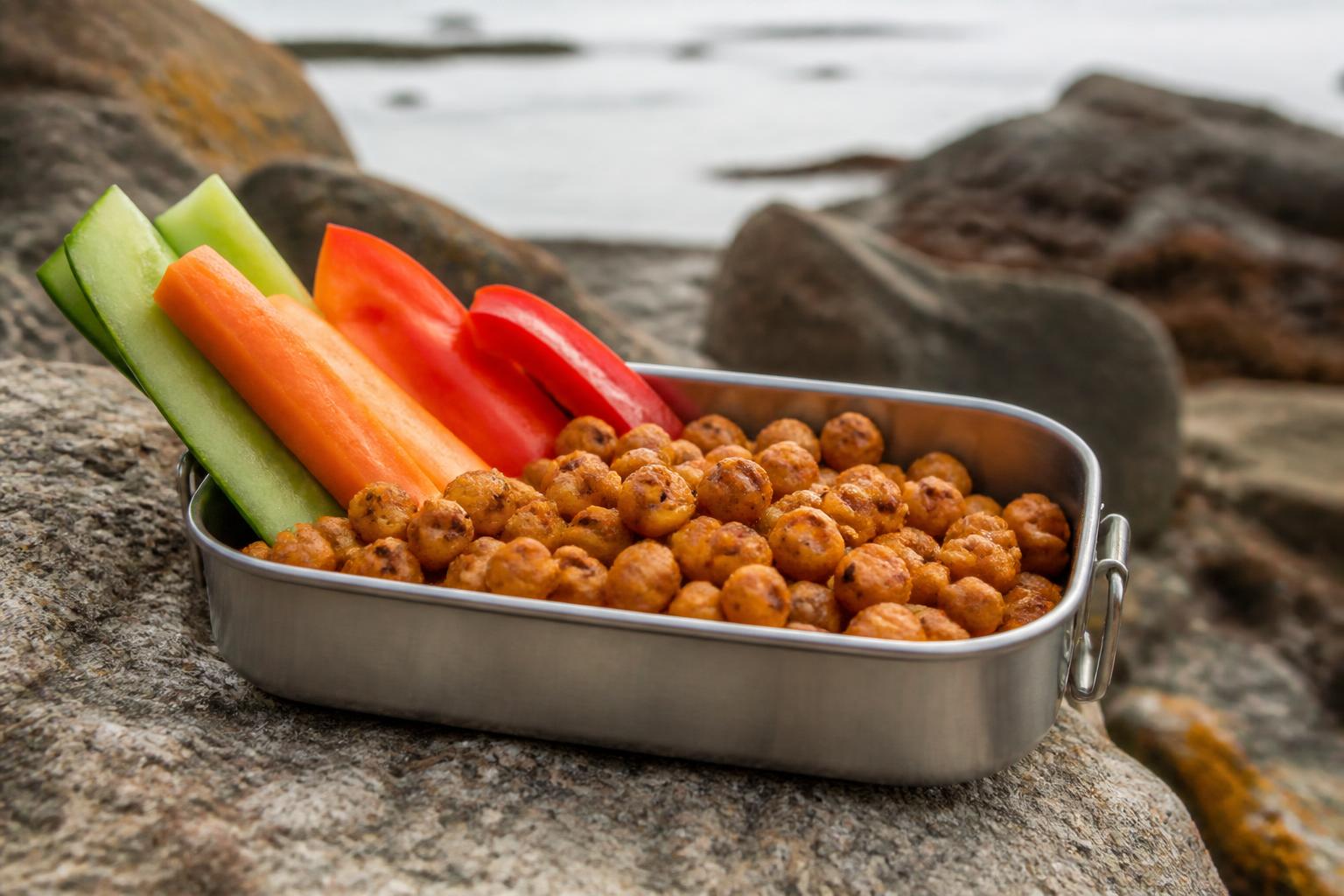
If you want crunchy work snacks that can cope without a fridge, the first question is not flavour. It is storage. We sort ideas by three things: what the pack says, whether the food is still sealed, and how long it will be in your bag before you eat it. That simple filter stops a lot of wishful packing.
For a short trip across town, you have more flexibility. For a full workday, the safe options narrow quickly to foods that are shelf-stable and still unopened. That is the backbone of practical, crispy snacks for everyday habits, especially when your “office kitchen” is a desk drawer, a train seat or the passenger footwell.
How to choose crunchy snacks for a workday without a fridge
The main rule is straightforward. Start with the label, then consider whether the item is sealed or opened, then think about carrying time.
A sealed ambient product is in a different category from a homemade pot, a cut pepper, or a half-used tub of dip. “Ambient” here means designed to be stored at room temperature before opening. If the pack says store in a cool, dry place and does not require chilling until opened, that is your clearest sign it may suit an unrefrigerated workday. If the pack says keep refrigerated, that instruction matters from the start. If it says refrigerate after opening, then an opened pack is no longer the same proposition as a sealed one.
The next question is how long you will carry it. A snack that is reasonable for a morning commute and a mid-morning break is not automatically a safe desk-drawer item until 4 pm. This is where people often blur convenience with safety. Crisp texture does not equal shelf stability. A crunchy carrot batons and a crunchy rice cake may share a bite, but not a storage rule.
Finally, think about the state of the food. Sealed, factory-packed foods with clear ambient storage instructions are the easiest to manage. Opened, cut, cooked and homemade foods need more care because their storage life depends on ingredients, handling and temperature. If you are packing at 7 am and eating at 11 am, that is one decision. If you are packing at 7 am and hoping it survives a warm room until your train home, that is another.
If you want a simple way to plan combinations by texture and pack format, our snack combo planning guide for crunch, balance and portion size is a useful place to start.
Best options for the shortest carrying window
For a few hours out of the house, you can widen the menu a little, but “a little” is the key phrase. This is the zone for a commute, a morning in a co-working space, or a short errand before you eat. Some foods that are not suitable for all-day room-temperature storage may still be workable for a short carrying window, especially if you use an insulated lunch bag and a chilled pack.
Examples for a short window include:
- Cut vegetables such as carrots, cucumber or peppers, packed cold from the fridge
- A small pot of hummus or yoghurt dip, if kept chilled in an insulated bag with an ice pack and used within a short period
- Homemade roasted chickpeas or toasted seeds, if fully cooled and packed dry
- Cheese crackers assembled at home, if kept properly chilled and eaten early
- Cold cooked edamame or lentil mixes, if transported in a chilled bag and not left in a desk drawer
The practical point is that homemade or cut ingredients often need active temperature control, not just optimistic packing. A canvas tote is not a fridge. If your snack includes chilled ingredients, especially dips, dairy, cooked grains, meat or fish, use an insulated bag with a frozen gel pack and keep the carrying time short. If you cannot keep it chilled, choose something else.
This matters even when the food “looks dry”. Cut veg release moisture, opened dips have been exposed to air and utensils, and cooked grains can be more temperature-sensitive than people assume. A crunchy topping does not make the rest of the snack suitable for room-temperature storage.
Good short-window pairings include:
- Carrot sticks with a sealed single-serve hummus pot, carried chilled and eaten by mid-morning
- Cucumber rounds with a small portion of cottage cheese, again only if carried chilled and eaten soon
- Homemade toasted pitta shards with a chilled dip in an insulated bag
- Apple slices with peanut butter, if the nut butter itself is shelf-stable and the apple is only being carried briefly
Even here, read the label on bought items. Some single-serve dips are sold chilled and must stay chilled. Others are ambient until opened. Those are not interchangeable.
What works for a full day only if it is shelf-stable and sealed
For a full workday without fridge access, the most reliable category is sealed, shelf-stable food with clear ambient storage instructions. This is where convenience and low fuss line up best.
Practical examples include:
- Crispbreads in wrapped portions or a newly opened packet eaten the same day, according to pack guidance
- Crackers in sealed sleeves
- Rice cakes in unopened packs or individually wrapped portions
- Roasted chickpeas, broad beans or lentils in sealed retail packs labelled for ambient storage
- Nuts and seeds in sealed snack packs
- Corn snacks, popped chips or savoury crisp-style snacks in sealed packets
- Shelf-stable oatcakes
- Wasabi peas or similar dry pulse snacks, if sold as ambient products
- Freeze-dried vegetable or fruit crisps in sealed packs
The important qualifier is the one people skip: safety depends on the pack instructions and whether the item stays unopened. A roasted pulse snack sold in a sealed ambient pouch is one thing. Home-roasted chickpeas in a reused tub are another. A packet of crackers labelled store in a cool, dry place is straightforward. Crackers spread with soft cheese at home are not.
This is also the easiest category for desk drawers, lockers and work bags because the product has been designed for ambient storage before opening. Once opened, the label may change the rules. Some products simply need to stay dry and be eaten promptly for quality. Others may require refrigeration after opening, especially if they include dips, fillings or moisture-rich components.
Useful full-day combinations can be very simple:
- Oatcakes plus a sealed nut butter sachet
- Rice cakes plus a sealed portion of roasted edamame
- Crispbreads plus a small unopened pack of nuts and seeds
- Crackers plus a shelf-stable olive snack or ambient bean crisp pack
- A savoury mix of roasted pulses and pumpkin seeds, if bought as sealed ambient snack packs
These are the combinations that support everyday routine because they travel well, portion neatly and do not ask your workplace to provide the one thing it does not have. For more on which crunchy formats are easiest to buy, store and rotate at home, see our guide to buying crunchy snacks and storing them sensibly.
Why cut, opened and homemade crunchy foods need more care
This is the bit that deserves the most clarity. Crunchy foods fall into two very different camps.
First, there are sealed ambient foods. These are products that the manufacturer has packed and labelled for storage at room temperature before opening. Think crispbreads, crackers, rice cakes, roasted pulse snacks and many nut packs. Their safety depends on the label being followed and the pack remaining unopened until you are ready to eat.
Second, there are foods whose safety depends on chilling, short timing, or both. This includes cut vegetables, opened hummus, homemade dips, cooked grains, cheese, meat, fish, egg-based fillings and many leftovers. Some of these can be carried safely for a short period if kept cold in an insulated bag. They are not equivalent to shelf-stable snacks for an all-day unrefrigerated shift.
Current FSA guidance is the right reference point here. In the UK, the Food Standards Agency advises keeping chilled food out of the fridge for the shortest time possible during preparation and transport. Food that needs to be chilled should be kept cold, typically at 5C or below. The FSA also uses the familiar “2-hour rule” in practical consumer advice for perishable food left out at room temperature, with food left out for up to 2 hours generally able to go back in the fridge or be used, and food left out for longer needing more caution. For packed lunches and similar situations, the safe approach is to use an insulated container with an ice pack for foods that require chilling.
That means we should not treat these foods as all-day desk snacks unless the label specifically says they are shelf-stable. A few examples make the distinction clearer:
Cut vegetables: whole carrots and peppers are one thing; cut sticks are another. Once cut, they are more vulnerable to time and temperature, and quality drops quickly too. For a short morning carry, they may be fine if packed cold. For all day in a warm office drawer, they are not the best choice.
Opened hummus: a chilled tub that has been opened belongs in the fridge according to its label. It should not be treated like a shelf-stable snack just because the texture is thick.
Cooked grains: crunchy grain salads or toasted grain pots can sound robust, but cooked grains are not desk-drawer foods unless sold in a way that is clearly shelf-stable and labelled accordingly.
Cheese and meat: hard texture does not remove the need for chilling. Cheese crackers made at home, mini salami, cooked chicken strips or sliced ham need label-led handling and, in many cases, refrigeration.
Homemade roasted pulses: these can be lovely, but homemade is not the same as commercially shelf-stable. Moisture level, cooling, storage and cleanliness all affect how well they keep.
There is also a UK-specific point worth noting. Labelling and food safety rules are not always expressed in exactly the same way as broad EU guidance, and the advice UK readers should prioritise is the current FSA position and the storage instructions on products sold here. If a label says keep refrigerated, that is the rule to follow, regardless of whether a similar product elsewhere in Europe might be sold ambient.
Where storage depends on the label, say so plainly. We would rather have a snack idea ruled out than have an all-day bag quietly turn into a warm food cupboard.
How to build a crunchy snack combo that stays practical
The best work snacks have three jobs. They need to stay crisp enough to be enjoyable, stay safe for the way you carry them, and fit the rhythm of an adult workday. That usually means modest portions, low mess and packaging you can open one-handed between emails.
A good formula is texture plus staying power plus a carrying method that matches the food.
Try building from these patterns:
Dry base plus protein or fat, all shelf-stable Think oatcakes with a sealed peanut butter sachet, or crackers with a portioned nut mix. You get snap from the biscuit element and a little staying power from nuts or nut butter. This suits a desk drawer and a long day.
Crisp element plus a dry savoury extra Rice cakes with roasted chickpeas, or crispbreads with a pack of seeds. This keeps the whole combo in the ambient category if both items are labelled for room-temperature storage.
Short-window fresh crunch plus chilled dip Carrot sticks with hummus, or peppers with a yoghurt-based dip, but only if you can keep them cold in an insulated bag and eat them within a short period. This is more “commute snack” than “leave it on your desk until 3 pm”.
Individually portioned packets for stop-start days If your day includes trains, site visits or back-to-back meetings, small sealed packs are often the least annoying option. A sleeve of crackers and a nut pack are easier to manage than a large family bag that goes stale by noon.
A few practical UK work-routine examples:
For a standard office day with no fridge access, pack an unopened sleeve of oatcakes, a sealed roasted broad bean snack and a small pack of almonds. All can sit in a drawer if the labels allow ambient storage.
For a train commute with a mid-morning break, carry chilled cucumber slices and a small pot of hummus in an insulated lunch pouch with an ice pack, then add a backup packet of rice cakes in case plans overrun.
For a teacher, driver or field-based worker, favour snacks you can open and close quickly without crumbs everywhere. Individually wrapped crispbreads, roasted pulse packs and nut sachets tend to be easier than loose mixes.
For a long day with uncertain timing, build around the item with the strictest storage need. If anything in the combo needs chilling and you cannot provide it, swap that part out rather than hoping for the best.
Portioning matters too. Crunchy snacks are at their best when they stay dry and intact. Smaller packs help with that. They also stop the common cycle of opening one huge bag at 10 am and eating it because it is there, not because you are hungry.
If you want more ideas for balancing crunch, convenience and adult portion sizes, browse our snack idea builder for practical workday combinations.
The easiest rule to remember is this: match the snack to the storage conditions you actually have, not the ones you wish you had. Sealed ambient products are your safest all-day option. Fresh, cut, opened and homemade crunchy foods can still be excellent, but they need a shorter window, proper chilling, or both. That is how crunchy snacks stay practical, and how crispy snacks for everyday habits become a routine you can rely on rather than a gamble in the bottom of your bag.