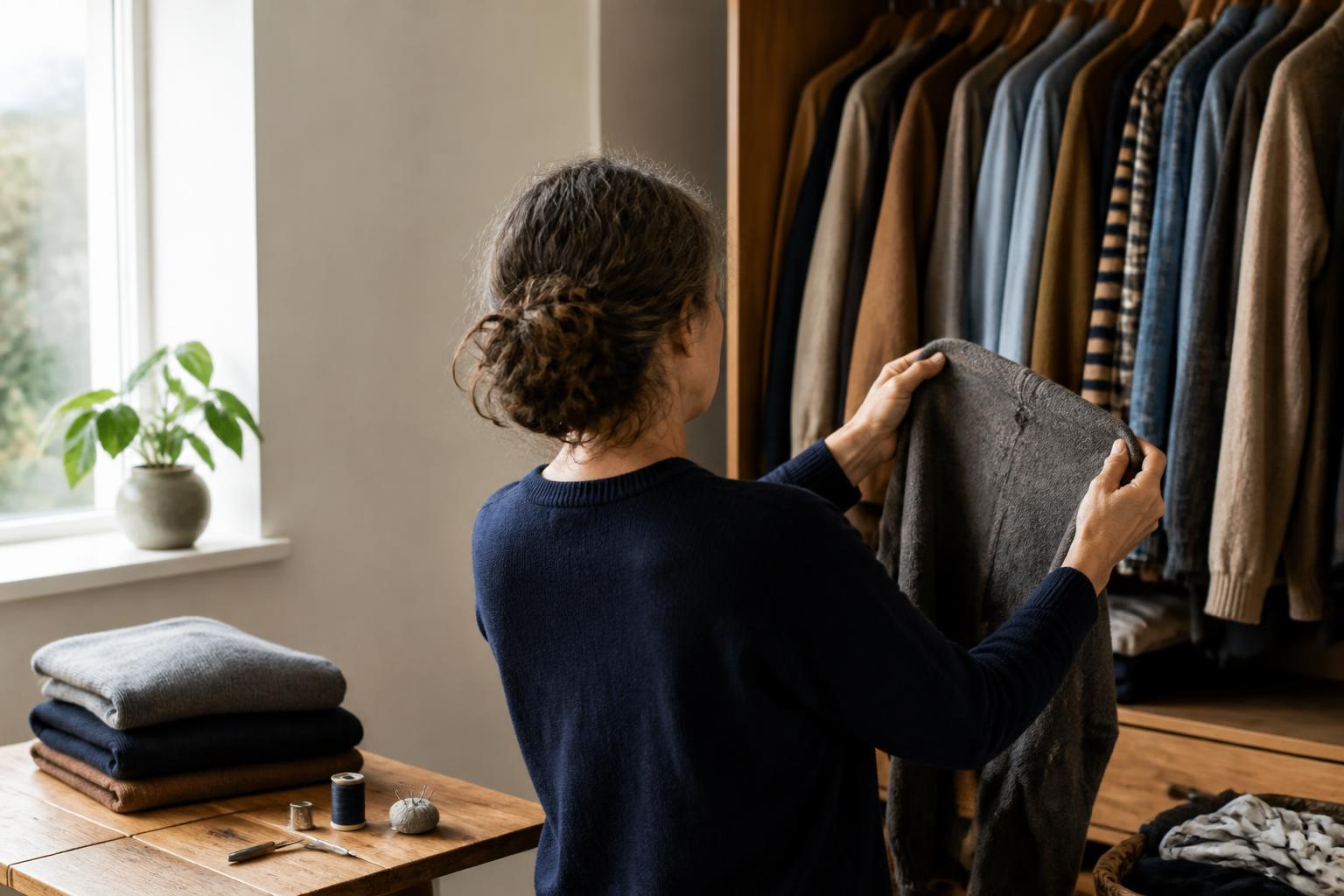
If you are wondering whether to repair or replace clothes, start with two questions. Does the item still fit the life you actually lead, and is the problem local or widespread? A missing button, split seam or fallen hem is often worth sorting. A coat that no longer fits, or jeans that are thinning in several places, usually need a different decision.
We do not need to turn every item into a moral test. The useful approach is simpler. Check the label, identify the fault properly, score the garment against a few practical criteria, then decide whether a repair is sensible, temporary, or not worth pursuing. That helps with the common wardrobe repair or replace question without guilt, guesswork or vague “sustainability” claims.
Start with the label and the fault - how to identify the actual problem and check whether the manufacturer care instructions limit what repair is sensible
Before deciding anything, identify the actual fault. “Worn out” is too broad to be useful. Look for the specific issue.
Common examples include:
- a seam has opened
- a button has come off
- a zip no longer runs smoothly or has failed
- a hem has dropped
- knitwear has moth holes
- elbows, knees or inner thighs are thinning
- elastic has lost stretch
- fabric has faded, distorted or felted
- lining has torn
- underwires or bra channels have broken through
Then read the care label. In the UK, garment care labels commonly follow recognised symbols, but brands vary in how much detail they give. The label will not tell you whether to repair, but it will tell you what kind of repair is sensible and what risks come with it.
Check for:
- fibre content, such as 100% wool, viscose blend, or elastane content
- washing restrictions, such as hand wash only or dry clean only
- heat limits for ironing
- warnings against tumble drying
- signs the item may shrink, distort or lose finish if mishandled
This matters because some repairs involve washing, pressing, steaming or patch attachment. A washable cotton shirt gives you far more options than a structured acetate-blend dress marked dry clean only. A wool jumper with a small moth hole may be repairable, but aggressive washing afterwards could make the result worse. A bonded raincoat, heat-sealed puffer or coated fabric can be especially awkward, because stitching or heat can compromise the finish.
Also check whether the “fault” is really a care issue. A zip that sticks may need cleaning or wax rather than replacement. A jumper that looks misshapen may recover after careful washing and drying flat. A shirt that gapes at the bust is not damaged at all, it is the wrong fit.
If you want a systematic once-over before deciding, use our clothing quality checklist for better buying and keeping alongside your label check. It helps separate a one-off repairable issue from a garment that was never built to last.
The five-point worksheet for repair decisions - how to score fit, structural condition, repair price, frequency of wear and sentimental value in a simple reader worksheet
When people get stuck on wardrobe repair or replace decisions, it is often because they are weighing five different things in their head at once. Put them on paper instead.
Score each category from 1 to 5.
1. Fit
- 5 = fits well now, comfortable, suits how you dress
- 4 = small issue, but still wearable
- 3 = wearable with compromise
- 2 = regular fit frustration
- 1 = does not fit or does not suit your life
2. Structural condition
This is the big one. Ignore the headline fault for a moment and assess the whole garment.
- 5 = fabric strong, seams sound, no obvious wear elsewhere
- 4 = one localised issue, otherwise solid
- 3 = some wear in other areas, but still usable
- 2 = thinning, distortion or multiple weak points
- 1 = broadly worn through, unstable or failing in several places
3. Repair price, relative to replacement value for you
This is not about chasing the cheapest possible fix. It is about whether paying for repair makes sense for that item in your wardrobe.
- 5 = low-cost or DIY, clearly worthwhile
- 4 = moderate cost, still sensible
- 3 = borderline, depends how much you wear it
- 2 = expensive for what the garment is to you
- 1 = repair cost feels disproportionate
If you do not yet know the exact cost, score this provisionally based on the type of job. Reattaching a button and replacing a lining are not in the same category.
4. Frequency of wear
- 5 = weekly or more
- 4 = often in season
- 3 = occasional but reliable
- 2 = rarely worn
- 1 = barely worn, or kept but not chosen
5. Sentimental value
Be honest here. Some items matter because they are tied to a person, event or period of life. Others are merely familiar.
- 5 = strong sentimental value
- 4 = meaningful and hard to replace like-for-like
- 3 = some attachment
- 2 = little attachment
- 1 = no real attachment
How to read the score
Add the five numbers.
- 21 to 25, repair is usually worth serious consideration
- 16 to 20, repair may be worthwhile if the fault is local and the process straightforward
- 11 to 15, pause and compare the effort with realistic future wear
- 5 to 10, replacement or letting go is often the more practical route
This is a guide, not a rule. Structural condition and fit should carry the most weight. A beloved coat with a score of 18 may still be worth mending. A badly fitting dress with a score of 17 may still not deserve more money.
When a repair is usually worth trying - which common faults are often manageable because the garment still fits, the fabric is sound and the damage is local
A repair is usually worth trying when three things are true. The garment fits. The fabric and construction are otherwise sound. The damage is local rather than systemic.
That often includes:
Missing buttons and loose buttonholes
If the fabric around the fastening is still firm, this is usually straightforward. Check whether a spare button is stitched into an inside seam or care label packet. If the buttonhole itself is fraying badly, that may need reinforcement too.
Open seams
A seam that has popped at the underarm, side seam or crotch can often be restitched if the seam allowance is intact and the surrounding fabric is not shredding. If the cloth beside the seam has worn thin, simple restitching may not hold for long.
Fallen hems
Trousers, skirts and dresses with dropped hems are often good repair candidates, especially if the original fold line is still visible and there is enough fabric to rework neatly.
Small localised holes
A single moth hole in knitwear, or a small snag-related hole in woven fabric, can be worth addressing if there is no broader thinning. On knitwear, the success of the repair depends a lot on fibre type, stitch structure and hole size.
Zip issues
Not every zip failure means full replacement. Sometimes the slider is worn, the track is obstructed, or the top stop has failed. If the zip tape and surrounding fabric are sound, this can still be worthwhile. If the zip area is also tearing away from the garment, the calculation changes.
Lining tears
A torn coat or skirt lining can often be patched or partially replaced if the outer fabric is still in good order. For a well-fitting tailored item, this can make sense.
Minor knitwear care and reshaping
A jumper that has stretched or lost shape may improve with careful reblocking, especially if the fibre responds well to washing and drying flat. Follow the care label, and be cautious with heat and agitation.
These are the kinds of faults where the repair route can extend useful wear without pretending the item is as good as new. If you need a basic process for checking condition before spending money, our wardrobe repair checklist for deciding what to mend is a good place to start.
When replacement is the more practical choice - which signs suggest the problem is broader than one repair, including poor fit, thinning fabric or repeated failure points
Sometimes the right answer is not another mend.
Replacement is usually more practical when the problem is broader than one repair, or when the repaired item still would not serve you well afterwards.
Watch for these signs:
The fit is wrong
If you do not wear something because it pinches, rides up, pulls, gapes or never feels like you, a repair will not solve the real problem. Alterations can help in some cases, but they are a different decision from repair, and not every garment has enough seam allowance or workable construction.
The fabric is thinning in multiple places
Inner-thigh wear on jeans, elbows on shirts, seat wear on trousers, and underarm thinning on knitwear often indicate general fabric fatigue. One patch may buy time, but if several areas are weak, more failures are likely.
The same point keeps failing
If the zip has been replaced before, the crotch seam repeatedly splits, or the underwire keeps breaking through, ask why. The cause may be strain, poor fit, weak materials or laundering that the garment does not tolerate well.
The repair would outlast the garment
There is little point paying for a technically perfect repair if the surrounding fabric is close to the end of its life. This is especially common with very lightweight jersey, brittle faux leather, heavily abraded denim and delaminating coated fabrics.
The care demands no longer suit you
A silk blouse that needs specialist cleaning and careful storage may be lovely, but if you never choose it because it feels too fussy, repairing it may not improve its chances.
The item was never very good
Low-quality construction shows up in twisting seams, unstable interfacing, bubbling fusibles, poor recovery in stretch fabric and rapid pilling or distortion. If the underlying quality is poor, one repair can become a series of repairs.
That does not mean the item must go straight to landfill. In the UK, options may include textile recycling, resale for parts or fabric, or keeping it for rags if the fibre and finish make that sensible. But it does mean we should not force a repair simply because repair sounds virtuous.
WRAP’s guidance on extending the life of clothing supports the broad principle that using clothes for longer matters, but it does not require us to ignore practicality. The useful question is not “Can this technically be repaired?” but “Will this repair result in a garment we will actually keep wearing?”
Worked examples using hypothetical numbers - how to apply the worksheet to everyday cases without presenting fabricated repair quotes or universal environmental savings
These examples use the worksheet only. They are not repair quotes, and they do not claim standard environmental savings.
Example 1, cotton shirt with a missing button and one open cuff seam
- Fit: 5
- Structural condition: 4
- Repair price: 5
- Frequency of wear: 4
- Sentimental value: 2
Total: 20
This is a strong repair case. The shirt fits, the faults are local, and the likely effort is modest. Even without sentimental value, it earns its place through usefulness.
Example 2, jeans with thinning inner thighs and a new small hole at one thigh
- Fit: 4
- Structural condition: 2
- Repair price: 3
- Frequency of wear: 5
- Sentimental value: 2
Total: 16
The score lands in the middle, but structural condition is the warning sign. Because the fabric is already thinning, one repair may not buy much time. If these are your only comfortable jeans, a temporary reinforcement could still be worth doing while you look for a replacement. If you already have alternatives, replacement is likely to be more practical.
Example 3, wool jumper with one moth hole, otherwise sound
- Fit: 5
- Structural condition: 4
- Repair price: 3
- Frequency of wear: 4
- Sentimental value: 3
Total: 19
Worth considering for repair, especially because the damage is local. Before mending, check carefully for further holes, inspect storage habits, and make sure the care label supports the cleaning method you plan to use.
Example 4, blazer that no longer fits at the shoulders, with lining tears
- Fit: 1
- Structural condition: 3
- Repair price: 2
- Frequency of wear: 2
- Sentimental value: 3
Total: 11
Even though the outer fabric may still be decent, the poor fit makes repair hard to justify. Lining repair alone will not solve the main reason it is not being worn.
Example 5, favourite coat with a broken zip, otherwise excellent
- Fit: 5
- Structural condition: 5
- Repair price: 3
- Frequency of wear: 5
- Sentimental value: 4
Total: 22
This is exactly the kind of item often worth saving. The coat already proves its value in wear, and the fault is specific.
What to do next if you keep or let go - how to choose a repair route, use The Eco Edit checklists and replace more carefully if the item is beyond practical repair
If you decide to keep the item, choose the repair route that matches the fault and the garment.
For simple jobs, you may be able to do it yourself. Buttons, basic hems and some seam repairs are manageable if the fabric is stable and the result does not need to be invisible. For more complex work, such as zip replacement, knitwear repair, relining or anything involving delicate, slippery or heavily structured fabric, a professional is often the sensible choice.
Before handing something over, note:
- the exact fault
- whether there are weak spots elsewhere
- the fibre content
- the care instructions
- whether you want a visible mend or a discreet one
- whether the item needs cleaning first, according to the label
If you are still deciding, run through our practical wardrobe decluttering checklist after the repair worksheet. It helps clarify whether the garment is genuinely part of your wardrobe or simply difficult to part with.
If you decide to let it go, do that deliberately too.
- resell if it is still wearable and the fault is minor and clearly described
- donate only if it is genuinely usable
- recycle textiles through a suitable scheme if the item is beyond wear
- keep a small amount aside for rags only where the fabric is appropriate
Then look at why the item reached this point. Was it poor fit from the start? A fibre that never suited your routine? Construction that failed early? A care label you kept ignoring because the garment was unrealistic for your life?
That reflection is what improves the next purchase. Replace more carefully by checking fibre content, seam quality, spare buttons, zip sturdiness, lining quality and whether the care instructions are ones you will actually follow. In the UK, that often matters more than chasing broad product claims.
The best wardrobe repair or replace decision is rarely the most heroic one. It is the one that leaves you with clothes that fit, function and get worn. If a repair will achieve that, mend it. If it will not, move it on cleanly, and buy the replacement with sharper eyes.