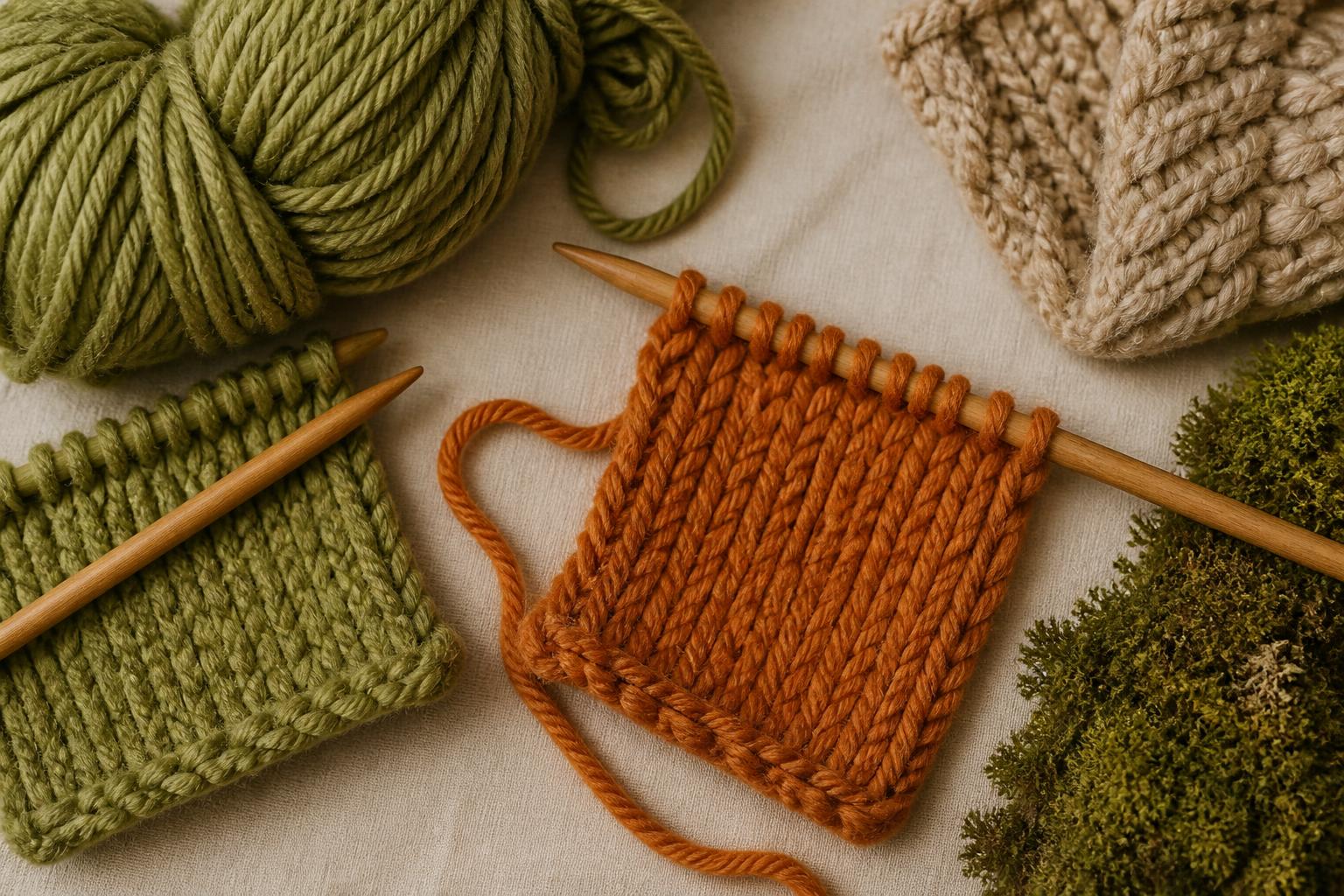
Choosing a pattern that suits your yarn is usually less about finding an exact label match and more about understanding what the yarn wants to become. A soft, lofty yarn can make a beautiful hat and a disappointing hard-wearing bag. A crisp yarn with excellent stitch definition can make cables sing, but may feel too firm for a drapey shawl. When we match yarn and pattern well, the knitting is easier, the fabric behaves properly, and the finished piece gets worn rather than left in a drawer.
The best place to start is with the yarn in your hand. Look at its weight, fibre, construction, and the kind of fabric it is likely to produce. Then read the pattern notes carefully before you buy extra balls or cast on. That simple order saves a great deal of disappointment, especially when comparing different knitting designs for the same project idea.
What makes a knitting pattern a good match for your yarn - how yarn weight, fibre, construction and intended fabric affect pattern choice
Most pattern choices begin with yarn weight, because weight affects scale, warmth, speed, and the sort of fabric you can achieve. If a pattern is written for 4 ply, it has been shaped around a much finer fabric than one written for aran or super chunky. Even when you can technically reach the same stitch count with a different yarn, the result may be too heavy, too stiff, or the wrong size altogether.
That is why we first compare the pattern's recommended weight with the yarn we plan to use. If they are close, such as DK instead of worsted, substitution may be straightforward with swatching and careful checking. If they are far apart, such as using super chunky in a DK jumper pattern, it is usually better to choose a different pattern.
Fibre matters just as much. Wool and merino have elasticity, which helps with ribbing, fitted garments, and textured stitches. Cotton has less bounce and often produces a denser fabric, which can work well for household items and some summer garments. Alpaca adds warmth and drape, but can grow under its own weight. Acrylic can be practical and easy care, but its stitch definition and blocking behaviour differ from wool. Blends sit somewhere in between and need to be judged on their dominant qualities.
Construction is often overlooked, but it affects the look of the knitted fabric. A tightly plied yarn usually gives clearer stitch definition, so it suits cables, twisted stitches, and crisp texture. A singles yarn or softly spun yarn can produce a haloed, gentle surface, lovely for simple stockinette or garter, but less sharp in highly detailed textures. A chainette yarn can feel light for its thickness and make a surprisingly airy fabric. Roving-style yarns can look beautiful but may pill or wear quickly in high-friction areas.
Then there is the intended fabric. Ask what the finished piece needs to do. A baby blanket should be soft and comfortable, but also practical to care for. A cardigan should hold its shape at the button band and shoulders. Socks need durability and memory. A cowl can be more forgiving because it does not bear weight in the same way. The same yarn can suit one of these projects and be entirely wrong for another.
This is where browsing different knitting designs becomes useful. A yarn may not suit the first pattern you had in mind, but it may be ideal for another project that asks for exactly its strengths. With super chunky yarn, for example, we would usually look for patterns that welcome loft, warmth, and bold texture rather than fine detail. If you are exploring shades for that sort of project, our colour palette inspiration for handmade projects can help you think about the finished look before you choose a pattern.
How to read pattern details before you commit - which pattern notes on size, tension, needles, shaping and skills matter most at the start
Before buying yarn for a pattern, we read the information page as carefully as the photographs. The photo tells you what is possible. The pattern notes tell you what is required.
Start with size information. For garments, check not only the finished chest size but also the amount of ease. Positive ease means the garment is designed to be larger than the body measurement. Negative ease means it is intended to stretch and fit closely. If a jumper has 10 cm of positive ease built in, choosing your usual size without noticing that detail can leave you with a garment far roomier than expected.
Next, look at tension. In UK patterns, tension usually means the number of stitches and rows over 10 cm, often measured in stocking stitch or in the main pattern. This matters because the entire sizing calculation depends on it. If the pattern states 12 stitches and 18 rows over 10 cm on 8 mm needles, and your yarn naturally produces 10 stitches over 10 cm on the same needles, your finished piece will be larger unless you alter the needle size or choose another pattern.
Needle information is also worth reading closely. Some patterns list a main needle size and one or more smaller sizes for ribbing, neckbands, or edgings. Circular needles may be used for flat knitting simply to hold a large number of stitches, so a pattern saying "80 cm circular needle" does not always mean the piece is knitted in the round. If a project uses double pointed needles, magic loop, or short circulars for sleeves or hats, make sure you are comfortable with the method before you begin.
Shaping details can tell you whether a project suits your confidence level. A garment worked in pieces and seamed asks for a different skill set from a top-down raglan worked in one piece. A shawl with simple increases may be relaxing. A fitted sleeve cap with rate-based decreases needs more attention. If a pattern uses short rows, provisional cast-ons, three-needle cast-off, or picked-up button bands, it is best to know that in advance.
Skill notes are not there to intimidate. They are there to help you choose well. A pattern marked "adventurous beginner" may still be manageable if only one new technique appears and the rest is straightforward. Equally, a pattern marked "easy" can be frustrating if the yarn and stitch pattern are a poor combination for your experience level. Dark colours, fuzzy fibres, and complex stitch patterns all make reading the knitting harder.
If you crochet as well as knit, be careful with terminology when moving between crafts. UK crochet terms differ from US terms, and confusion there can affect mixed-technique projects or decorative edgings. It is always worth checking which terminology a pattern uses.
Why tension and yarn quantity decide whether a project works - how to use a tension square, compare metreage and estimate enough yarn for the project
If we had to pick the two checks that prevent the most disappointment, they would be making a tension square and comparing metreage.
A tension square is more than a quick formality. For knitting, we cast on enough stitches to measure the central 10 cm accurately, which usually means making a swatch larger than 10 cm square. Edge stitches distort measurements, so they should not be included. We knit in the same stitch pattern the project uses, wash or steam the swatch as the finished item will be treated, let it dry fully, and then measure stitches and rows over 10 cm in the centre.
Why wash the swatch first? Because many fibres change. Wool can bloom. Merino can relax. Cotton can settle. Super chunky yarn can open up noticeably after washing. Measuring before and after tells us whether the fabric remains stable enough for the project.
If the stitch count is too low, each stitch is too wide and the finished item will come out larger. We go down a needle size. If the stitch count is too high, we go up a needle size. Row tension matters too, especially in garments with yokes, sleeve caps, or length instructions tied to row counts.
Metreage is the other essential comparison. Ball count alone is unreliable because one 100 g ball of one yarn may contain far fewer metres than another 100 g ball. When substituting, compare the total metres required by the pattern with the total metres available in your chosen yarn. Then allow a sensible margin for swatching, joins, and any changes in length.
For example, if a pattern needs 600 metres and your yarn provides 80 metres per 100 g ball, you would need at least eight balls for the raw total of 640 metres. In practice, we would usually want a little breathing room, particularly for garments, matching stripes, or any project where running short would be awkward. If you are between sizes, making longer sleeves, or uncertain about your tension, buy the extra ball if it is available from the same dye lot.
Patterns with texture often use more yarn than smooth stocking stitch. Cables draw the fabric in and consume extra length. Brioche is notably yarn-hungry. Lace can use less yarn in one direction but may grow significantly after blocking. A pattern's stated quantity already accounts for its own structure, but if you are adapting the design, adding length, or changing stitch patterns, your estimate needs to change too.
This is also why substituting yarn by weight alone causes problems. A 500 g project in one yarn is not automatically a 500 g project in another. The more reliable route is always tension first, metreage second.
Choosing colour, texture and dye lot with the finished look in mind - how colour changes, stitch definition and dye lot consistency influence the result
The right colour can make a simple pattern look elegant, while the wrong colour can hide all the work you put into it. When choosing yarn for a pattern, we think about how the stitch pattern will read from a distance as well as close up.
Complex texture usually shows best in solid, semi-solid, or gently tonal shades. Deep cables, moss stitch, and twisted ribs can disappear in heavily variegated yarns. That does not make variegated yarn a poor choice, only a different one. It often shines in plainer knitting designs where colour is the main event and the stitch pattern steps back.
Conversely, a very simple shape in one-colour stockinette may benefit from a more lively shade. Tonal colour variation can add interest without interrupting the fabric. Self-striping or long colour change yarns can be wonderful for accessories, but they may pool unexpectedly in garments depending on circumference and stitch count.
Texture and colour interact. Dark shades make stitch definition harder to see while knitting and in the finished piece. Light shades reveal more detail and are often kinder when learning a new stitch pattern. Haloed fibres soften outlines. Smooth yarns sharpen them. If you want a gansey-style texture, a smooth plied yarn usually serves you better than a fluffy one. If you want a cosy cloud-like cowl, softness and bloom may matter more than crisp detail.
Then there is dye lot. If you are buying multiple balls of the same shade, check that they share the same dye lot wherever possible. Even small differences can show as visible bands in a larger project. This is especially noticeable in plain areas such as stocking stitch jumpers, blankets, and scarves.
If you do need to use two dye lots in one project, alternate balls for a few rows at each transition so the change blends rather than forming a line. We also recommend buying the full quantity for the project at the start if you can, rather than returning later and hoping the same dye lot is still available.
When planning colours, it can help to start with the use of the item. A practical everyday hat may suit a shade that works across coats and scarves. A statement accessory can carry a brighter choice. If you are still deciding, our super chunky merino colour options are a good place to compare how bold and neutral shades might behave in simple, textural projects.
Planning practical projects with super chunky merino - where World of Wool Chubbs super chunky merino is most suitable and what to consider for care and wear
World of Wool Chubbs is a super chunky merino yarn, and that combination tells us quite a lot before we even choose a pattern. Super chunky means quick progress, bold stitches, and substantial fabric. Merino brings softness, warmth, and a pleasant hand. Together, those qualities make Chubbs especially suitable for projects where comfort, impact, and speed matter more than hard-wearing abrasion resistance.
In practice, that means hats, cowls, scarves, simple mitts, and cosy home accessories are often strong choices. Chunky rib hats, oversized neck warmers, beginner-friendly garter stitch scarves, and straightforward textured cushions can all make good use of this type of yarn. Simple knitting designs with large-scale ribs, seed stitch, basket textures, or broad cables usually suit it better than highly intricate motifs.
For garments, we would be more selective. A cropped outer layer or a relaxed sleeveless piece may work nicely, but a long heavily worked cardigan in super chunky merino can become weighty and warm very quickly. The thicker the yarn, the more important it is to think about bulk at seams, underarms, and necklines. A pattern with clean shaping and realistic expectations for the fabric will generally perform better than one adapted from a finer yarn style.
Care and wear deserve proper thought. Merino is soft, but softness can come with trade-offs. In high-friction areas, such as underarms, cuffs, and bag-rub points, a soft yarn may pill sooner than a firmer, more tightly spun wool. That is not a fault so much as a characteristic to plan around. We would not usually choose a very soft super chunky merino for slippers that will be scuffed across floors every day, or for a heavily used tote bag expected to carry weight.
For care in the UK, always follow the yarn band instructions for the specific product you have bought. As a general rule, merino projects benefit from gentle handling, cool water, minimal agitation, and drying flat to support the fabric. Hanging a wet super chunky item can stretch it. This matters especially for cowls, jumpers, and anything with length that gains weight when damp.
It is also wise to think about the recipient. A quick-knit baby gift in super chunky merino may be lovely, but only if the care routine suits the household. A handwash-only item is not always the most practical choice for every family. Matching the yarn not only to the pattern but also to the real life of the person using it is often what turns a successful make into a well-loved one.
At Native Yarns, operated by Fleeta Limited, we find that the best projects begin with honest materials planning. If your yarn is World of Wool Chubbs, lean into what it does well. Choose patterns that welcome warmth, softness, and statement stitches. Make a proper tension square. Check metreage rather than trusting ball count. Buy enough from one dye lot. And if a pattern asks the yarn to behave like something finer, firmer, or more hard-wearing than it is, pick a different project. That is how we end up with finished pieces that look right, feel right, and last as they should.