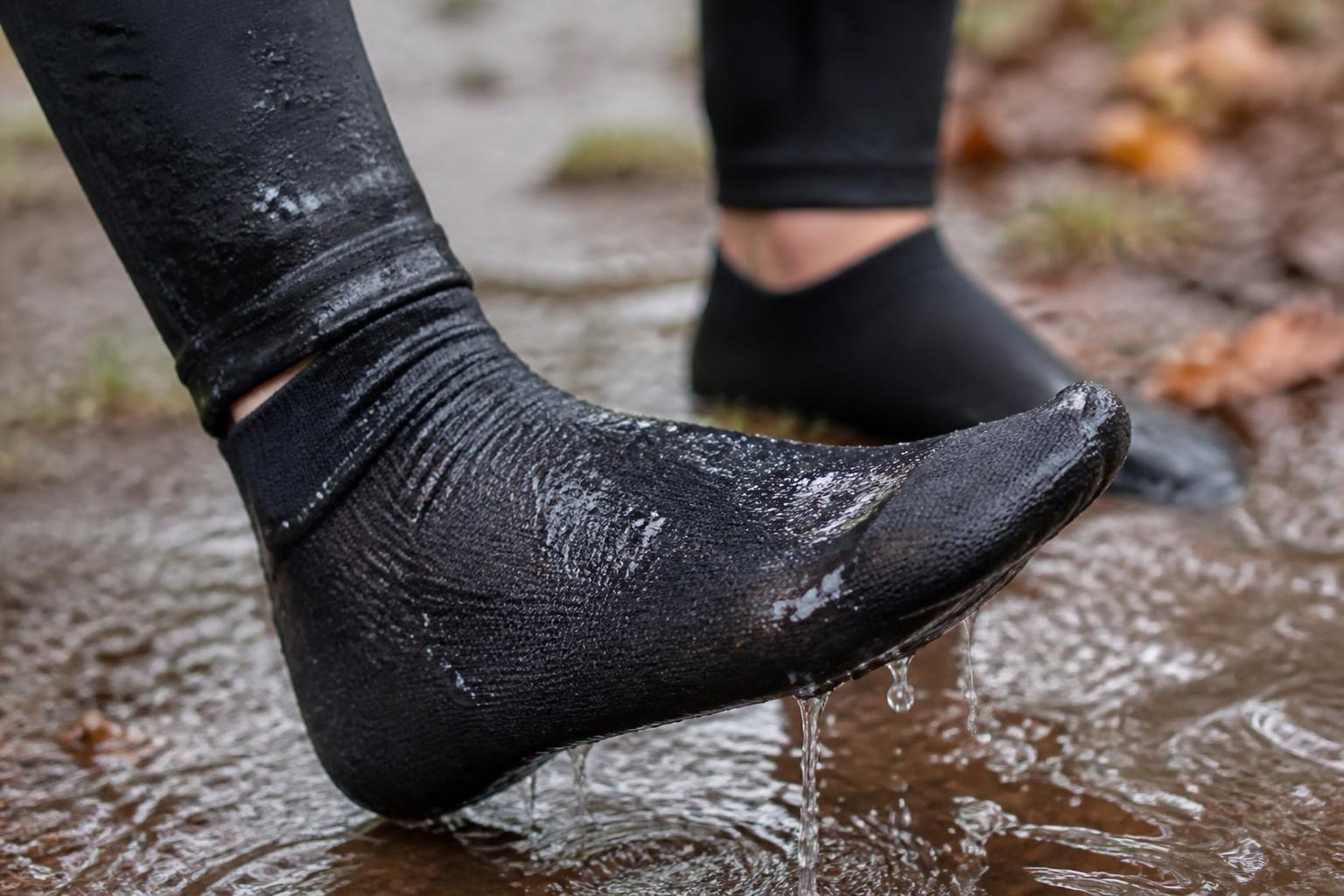
Wet UK runs do not always call for more kit. Often they call for the right kit in the right place. If your feet are the first thing to go cold, or if a short stretch of standing water can turn an easy run into a squelchy one, waterproof socks for running can make a real difference. They are not magic, and they will not keep every run completely dry, but in the right conditions they can keep your feet warmer, more comfortable and less distracted by the weather.
That matters most on ordinary British runs. A damp park loop after work, a road route with flooded kerbs, a canal path in winter, or a mixed road-to-trail social run where you cannot avoid mud and puddles. In those situations, the question is not whether your kit looks technical. It is whether it helps you keep moving comfortably for the run you actually do.
What waterproof running socks actually do
Most waterproof running socks use a layered construction. In simple terms, there is usually an outer fabric for durability, a waterproof membrane in the middle, and an inner lining that sits against the foot. The membrane is the part that aims to stop external water getting through while still allowing some internal moisture, mainly sweat vapour, to escape.
That is the theory, and it works well within limits. If you run through wet grass, splash through shallow puddles, or spend an hour on rain-soaked paths, a good pair can stop a lot of that outside water reaching your skin. They can also reduce wind chill around the foot, which is often just as valuable in the UK as keeping rain out.
What they cannot do is override every route choice and every weather condition. If water pours in from the top of the sock, the membrane will not save you. If your shoes are saturated and cold, the socks may keep your skin drier for a while, but your feet can still feel clammy or chilled. If you sweat heavily, moisture from inside the sock can build up faster than it can escape. That is why "waterproof" does not always mean "dry".
For runners, that distinction matters. Dry can mean three different things on a wet run. It can mean no rainwater touching your skin. It can mean your feet feel warm enough to ignore. Or it can mean the whole shoe and sock system dries quickly afterwards. Waterproof socks help most with the first two, not always with the third.
They are also different from standard water resistant fabrics used elsewhere in running kit. A cap might shrug off drizzle for a while. A glove might block wind and light rain. A sock has much harder work to do because it is compressed inside a shoe, flexing thousands of times, and regularly exposed to puddles, mud and grit. That is why fit and construction matter so much more than the word on the label.
If you are comparing options, it is worth starting with a realistic expectation. Waterproof socks for running are best seen as a comfort tool for wet and cold conditions, not a guarantee that your feet will stay perfectly dry in every downpour.
When they are worth wearing in the UK
In the UK, they earn their place most often in shoulder season and winter, when the ground stays wet for days and route surfaces vary from one street to the next. You do not need mountain weather for them to be useful.
Rain on its own is not always the deciding factor. If you are running on roads in steady rain and avoiding standing water, ordinary running socks may be enough, especially if temperatures are mild. Your feet may get damp, but not necessarily uncomfortable. Waterproof socks become more useful when rain combines with cold air, poor drainage and repeated splashing.
Puddles are the obvious example. On many UK roads and park paths, you can avoid the first one and not the fifth. Once you are choosing between ankle-deep kerbside water and stepping into traffic, your socks stop being a minor detail. Waterproof socks can reduce that immediate soaking feeling and help your feet stay warmer for the rest of the run.
Winter paths are another common case. Muddy towpaths, leaf-covered trails, bridleways and compacted park routes often hold surface water long after rain has stopped. Even when water does not fully soak through a standard sock, constant contact with cold wet uppers can leave your feet chilled. A waterproof layer helps by separating your skin from that cold, damp environment.
Mixed road-to-trail routes are where many recreational runners notice the benefit most. You might start on tarmac, cut through a park, cross a muddy field edge, then head back on pavement. That sort of route is common on club nights and social runs, and it is not always worth changing shoes just for one wet section. Waterproof socks can make that mixed terrain feel much less fussy.
They are also useful if you are returning to running and know that cold feet make you cut sessions short. Comfort matters more than purity. If drier, warmer feet keep you out for 40 minutes instead of turning back after 15, the socks have done their job.
When are they less worth it? Warm summer rain is the main one. If the air is mild and your route drains reasonably well, a lighter standard sock usually feels better. Waterproof socks can feel too warm, and once the run is over they often take longer to dry. They are also less compelling for short runs where getting a bit wet simply does not matter.
How to choose a pair that feels right on the run
The best pair is the one you forget about once you are moving. That starts with fit.
A waterproof sock should fit closely without pinching. Too loose, and the extra material can bunch and rub. Too tight, and you can compress the membrane and lining so much that comfort and circulation suffer. If you sit between sizes, think about how your feet behave on the run. If they swell noticeably, a cramped fit can become a problem quickly.
Height matters more than many runners expect. An ankle sock leaves more chance for water and grit to enter from above. A crew height gives more overlap with leggings or a tighter lower hem on running trousers, and more protection from wet grass, shallow mud and spray. For many UK conditions, that extra height is more useful than an ultra-low profile feel.
Thickness is the next trade-off. A thicker waterproof sock often feels warmer and more cushioned, which can be great in winter. But thickness also changes shoe fit. If your usual shoes already fit snugly, a bulky sock can create pressure over the forefoot or toes and lead to numbness, hot spots or blackened nails on longer runs. Before committing to a pair for race day or a long Sunday run, wear them on a shorter outing with the shoes you actually use in bad weather.
Seam comfort matters because waterproof socks can feel less forgiving than standard knit running socks. Check the toe area in particular. A seam that is merely noticeable when standing can become irritating after a few miles. The same applies to the cuff. It should stay up without digging in.
Warmth is personal, and so is your tolerance for a slightly more structured feel underfoot. Some runners love the protected, insulated sensation. Others prefer the softer, more breathable feel of ordinary socks even when conditions are poor. If you already run warm, look carefully at whether you need full waterproof construction or simply a better quality standard sock from our running sock range for everyday miles.
Shoe volume is the practical check that prevents most mistakes. Waterproof socks take up more space than thin road socks. If your shoes are close fitting, especially in the toe box, test the full setup before using it on a long run. If needed, a different insole thickness can help fine tune fit, and our running insoles for comfort and fit adjustments are worth a look when shoes feel slightly too shallow with winter socks.
How to wear them with the rest of your kit
Wet-weather running kit works best when each piece solves one problem without creating another. Waterproof socks should fit into that same approach.
Start with the conditions from the ankle up. If it is wet and cool, pair them with shorts if you naturally run warm, or leggings if wind and temperature are the bigger issue. There is no rule that says wet weather always means full winter kit. Many UK runners are more comfortable with warmer feet and bare legs than with heavy layers everywhere.
A good base layer choice matters because overheating at the torso often makes everything else feel wrong. If your upper body is too warm, your feet may feel clammy regardless of what your socks are doing. Keep the core comfortable, not baked. A light running and training clothing layer for changeable weather is usually more useful than piling on extra bulk. We stock practical options across tops, leggings, shorts and fleece layers, including pieces you can combine with a simple base layer rather than turning every wet run into a winter expedition.
Gloves are often a better upgrade than another top layer. Cold hands can make an easy run feel miserable even when the rest of you is fine. The same goes for a cap or headwear. Keeping rain out of your eyes and reducing heat loss from the head can make the whole run feel calmer, especially in wind-driven drizzle. Our caps and headwear for rainy or windy runs are useful for exactly that sort of ordinary British weather.
Try not to overcomplicate lower-body kit. Waterproof socks do not need special leggings or trail-only shorts. They simply work best when the hem of your leggings or tights sits neatly above the sock without bunching, and when nothing channels water directly into the cuff. If you wear arm sleeves, choose them for temperature control, not because the weather looks dramatic. Keep the system simple.
For cyclists who also run, it is worth separating expectations. Kit choices for a wet ride, such as bib shorts or heavier oversocks, do not always translate neatly to running. Likewise, some thermal technologies used in winter apparel, including KYMIRA in selected products, may help with warmth elsewhere in your kit, but they do not change the basic role of your socks. On foot, comfort still comes down to moisture management, fit and shoe space.
The trade-offs compared with ordinary running socks
The biggest advantage of waterproof socks is obvious. They offer more protection from external wet. The biggest compromise is also obvious once you wear them. They are usually less breathable than standard running socks.
That affects comfort in two ways. First, if you sweat a lot, your feet may still feel damp from the inside even when rainwater is kept out. Second, they can feel warmer and heavier, particularly once the run gets going. Some runners like that secure, insulated feel. Others feel boxed in.
Drying time is another realistic downside. Ordinary running socks can often be washed, air dried and ready again quickly. Waterproof socks usually take longer, especially if the inner lining has absorbed moisture. If you run frequently in winter, that matters. You may want more than one pair, or you may decide to save them for the wettest days rather than using them as your default.
The feel on the foot is different too. Standard socks tend to be softer, stretchier and more natural inside a road shoe. Waterproof socks can feel more structured, sometimes slightly stiffer, depending on construction. That is not automatically bad, but it is noticeable.
Weight is rarely the deciding factor for everyday runners, but it is still part of the picture. A waterproof sock is typically heavier than a thin ordinary sock, and once fully wet on the outside it can feel more substantial again. For a social 5K in winter, that may not matter at all. For a faster session where you want the lightest, coolest setup, it probably will.
Everyday usefulness is where standard socks still win. For dry runs, gym sessions, warm-weather miles and quick laundry turnaround, ordinary running socks are more versatile. Waterproof socks are more specialised. That does not make them niche in a bad way. It simply means they solve a particular UK problem very well and are less necessary the rest of the time.
Care, lifespan and signs a pair is not right for you
Waterproof socks usually last best when they are washed gently and dried patiently. Follow the care label on the pair you buy. In general, use a cool or moderate wash, avoid harsh fabric conditioners, and let them air dry rather than forcing them onto strong direct heat. Radiators, tumble dryers and very hot airing cupboard conditions can shorten the life of technical membranes and bonded layers.
Turn them inside out if the care instructions allow, especially after muddy runs. Grit, dried sweat and trapped dirt all increase wear over time. The cleaner the inner lining stays, the more comfortable the sock tends to remain.
Durability depends on more than washing. Shoe fit is a major factor. If the sock is constantly compressed or rubbing hard against the inside of a tight shoe, the fabric and membrane will wear faster. Long toenails, rough insole edges and repeated twisting when pulling socks on can all take their toll too.
You will usually know quite quickly if a pair is not right for you. Common signs include rubbing at the heel or toe, pressure across the forefoot, overheating on runs that are only mildly cool, or a cuff that feels irritating rather than secure. If water is entering from the top regularly, the issue may be height rather than quality. If your toes feel cramped, the issue may be thickness or size. If your feet feel swampy rather than protected, you may simply prefer a breathable standard sock for most runs.
That is worth saying clearly because there is no single best answer for everyone. Some runners will reach for waterproof socks for running every time the forecast looks grim. Others will keep one pair for flooded winter routes and use ordinary socks the rest of the year. Both approaches are sensible.
At Fair Weather Runner, our Field Notes are about making those choices with open eyes. We are part of Fleeta Limited, and we focus on practical kit for the conditions runners here actually face. If wet feet are spoiling your winter miles, waterproof socks can be a very good solution. Just choose them for the right runs, fit them properly, and build the rest of your kit around comfort rather than complication.